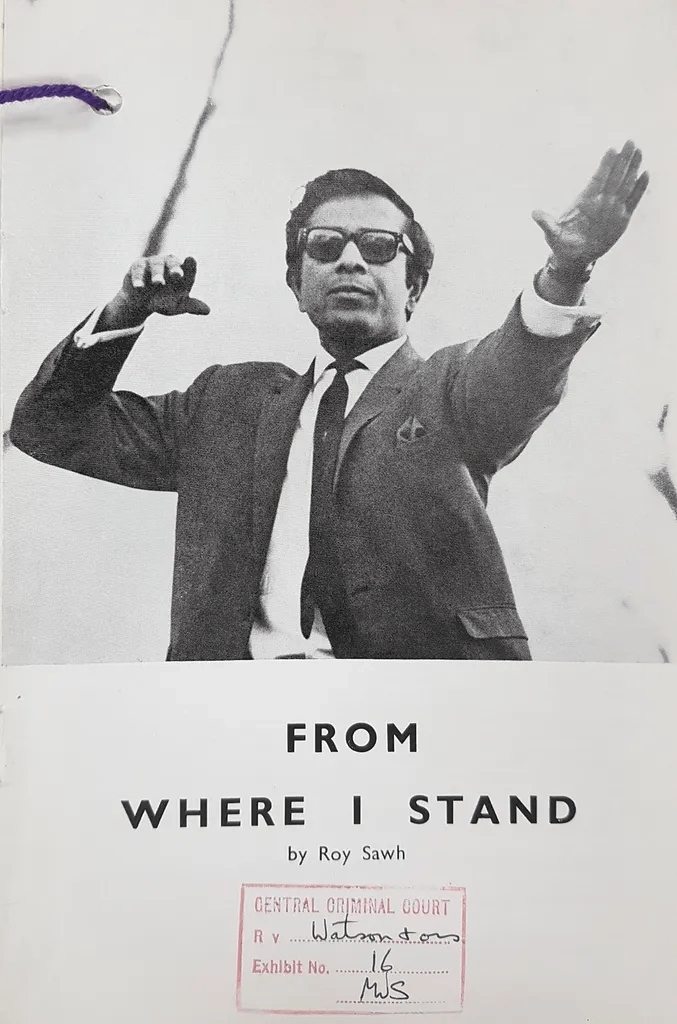
Roy Sawh arrives in London, mobilises against racism in Moscow
Chapter Three
And so on a misty March Sunday in 1958 Roy Sawh arrived in Britain with the wonderful knowledge that he had come to “do well”, and would soon return to Guyana a rich man and relieve his mother once and for all of the continual anxiety of where the next slice of bread would come from.
“I expected to return to Guyana within two or three years with bags of money and a world of knowledge. I could already envisage in my mind’s eye the scenes on my return to Uitvlugt.
“Tell us about the Houses of Parliament, Roy. The Queen? The Crown Jewels.” I was not really afraid. Was I not knowledgeable with English and about English history? The Wars of the Roses. The Restoration. Good Queen Bess. The Thirty Years’ War. I considered it part of my history as well. That’s how I rationalised my coming to England.”
His first shock in Britain, which he now regards in retrospect as a joke, was when he saw a white man – a porter – carrying luggage at Victoria main line railway station. He could not believe his eyes, and if that was real he did not believe that he was in London. “I had been brought up to regard such menial jobs as being above the white man. Only black people did that kind of work in Guyana. I was so flabbergasted that I went up to a bobby and asked him whether I was in London!” More surprises were forthcoming when he saw the elderly white women cleaning and sweeping toilets as lavatory attendants. “I got scared atvthe anonymity of the whole thing. It was something completely new to me.”
The friend who was supposed to have met him at the station never turned up. Just as he was becoming worried and afraid, a Jamaican befriended him, listened to his story and took him to Riverside Road, Stoke Newington, to stay with him. “It was very natural, I felt, for a black man to approach me and befriend me. It was like back home. If a white man had approached me I would have been terrified.”
So with thirty shillings in his pocket Roy became another resident in one of London’s back streets. He was told to register at the Labour Exchange and after filling in some forms, and producing his passport he got unemployment benefit. “I could not understand it. Here was I looking for a job and then getting some money for not having a job. The only thing I could say was ‘what a great country’. I did not have any hang-ups then about receiving dole, as I would now. I had not applied for it and at first I thought they must have made a mistake.”
His first experience of racial discrimination came when he had to look for accommodation. Landladies had suddenly “let their room earlier” when they saw him after assuring him on the ‘phone half an hour before that they had vacancies. “It is only now I know it was racism. At that time I thought it was my fault. Maybe I had not heard correctly. My English was probably not so good and they might have heard incorrectly.”
I did not mind. I thought I was the one who was in the wrong. I can see now why so many black people accept racism. They are prepared to make excuses and bend over backwards to people who practise racism. It is still part of an inferiority complex and the colonial mentality.”
He was so disgusted and ashamed at leaving his job that he dared not write to his mother. “She would have sighed and said it was typical of me. It would seem as if I could not keep a let her decally Another iod as a clus followed, He spent ea walking from factory to factory looking for that job. It was a pleasant job which he held for three years. For the first time he had time to spare and used ioby enroling a night school for a
course in accountancy.
With plenty of time during weekends he used to visit “lively” spots in London. Piccadilly, St James’ Park and Hyde Park, places which gave him entertainment and cost nothing. At Speaker’s Corner, Hyde Park, he drifted towards the platform which had a black speaker who was a Communist Party member. “I saw this black chap with a C.P. banner and was intrigued. For the first time in my life I was going to see and listen to a live communist. It was exciting and something like forbidden fruit. In Guyana, according to folklore, communists were very bad. Little did i know the effect this experience would have on me.”
As he listened to the speaker analyse society and its ills, he convinced me that he came from Guyana. “What he said seemed to apply so correctly to my country. He spoke of racism and colonialism and showed how the colonial powers like Britain were exploiting the colonies.” This was his first introduction to a Marxist analysis of society.
The next Sunday he again hurried to Speaker’s Corner and this time asked the speaker whether he could also speak. “I could not say a thing at first. Apart from being heckled, I was dumbstruck. Nothing seemed to come out from me. It was as if I was in shock. But worse still, I suddenly realised that I had nothing to say. I was humiliated.” That Sunday, and everyday afterwards, he bought newspapers and started reading them greedily. He joined a library and read Colin Cross’ book The Fall of the British Empire which described colonial exploitation in detailed form. This made a deep impact on him. “No other book shaped my thinking like Cross’ book.” A new horizon was opening for him. He met new friends at the classes he was attending at night school. “We used to discuss things, how we felt, what were our problems and experiences. I started for the first time to realise that our problems were all the same — difficulties in getting a job, accommodation and racism.”
He could not understand why English people seemed so prejudiced, especially when he remembered how whites on the sugar estates – which they mostly owned – were concerned about black people, where they lived, the jobs they had: ney seemed so reasonable then. He wondered whether it was because black people were now in their country, and were a threat to them, that they discriminated against them. “I did not know. It was new to me. I thought maybe we were in the wrong. I still could not analyse the reasons.”
He read more books, and concentrated on those dealing with politics and economics. At about the same time his contacts among black people grew, and so did the realisation that there was a lot amiss in British society. He could sympathise and listen to complaints by his fellow black people, but could do nothing. “I felt I was powerless to do anything constructive. It was like a nightmare to me. But what could I do? I could see no answer and my vision was not clear enough to attempt anything. So the next best thing I did was to try to develop myself. That is, I wanted to know more about life. What made things go in a particular direction. I developed an insatiable appetite for reading. For asking questions, for listening.” With this new lust for knowledge and information, his interest in accountancy sagged. He became more interested in public administration. “I had the vague idea that would help me in my relations with people.”
During the summer more black people emerged into the open from their winter hibernation. Hyde Park and other public places once more became Roy’s haunt. From the number of people who were congregating around his platform he realised that he was getting good at the game of public speaking. He gained more confidence and sensed the power that there was once you had the audience in your grasp. To maintain the interest of his audience he had to keep up with current events. He spent more time reading newspapers. He also cultivated a group of friends, mostly from the West Indies, but especially from Barbados. “They seemed to be around more often, interested and more articulate than other Westin-dians. Their discussions always seemed to end with the same conclusion – that black people were having a bad time in Britain and that it was the result of colour prejudice.
In 1961 he joined the British Guyana Freedom Association, which was Marxist in orientation. He was very pro-Moscow in philosophy. They discussed issues like independence in Guyana, which road Guyana was taking and whether violence was the only way out for Guyana. “Talks used to go on endlessly. They were very academic. We had plenty of time.” Then the next year he saw an advertisement in a Guyana paper in which Guyanese were offered scholarships to study in the Eastern European countries. Although he says that he was prepared to do anything to get a scholarship and in that way to get into university, it seems more likely that going to university was a secondary reason. The first was the opportunity to get to Moscow. It was a popular period for black people to go to the Eastern European countries. Offered a scholarship and given the choice of three East European universities, he chose Moscow. He left his job without giving notice. His excuse: “My values had changed, I was more interested in education and not material things.”
Once he got to Moscow he settled in quickly. He became more popular, met students from other colonial countries and got to know more about their countries. Two weeks after his arrival at university he called on students to form an Afro-Asian group and promptly caused a furore with the suggestion.
The purpose, according to him, was for students to get to know each other better, to discuss the conditions in their countries and how to act collectively. “But I did not realise that I was indirectly challenging the establishment in Moscow. They did not like anything to be formed without their prior permission and active involvement.”
From then onwards things did not go very smoothly between him and the Soviet university authorities. Black students started to complain about racial discrimination. “This was something new to me. I could well understand racism in a capitalist country like Britain. But a socialist country like the Soviet Union was the last place I expected any. I could not get over this. The whole thing interested me. I started asking a crucial question. Was there any real difference between Soviet socialism and Western capitalism? The answer to that is there even today in his views of the Soviet role in world politics, which are often sharply critical.
His next confrontation was during a seminar on international affairs at the university. A Soviet official spoke on the Congo. Roy says he was convinced that the official was twisting facts to suit the Soviet position. “I knew something about the situation in the Congo, having taken an active part in the various pro-Congo activities in London. All the official said was contrary to what I knew to be the situation. It was racist talk.” He started to ask embarrassing and leading questions.
“People realised that he was either not telling the truth or he did not know what he was talking about. The lecturer and I ended up in an argument. I hit the desk and walked out. I wasn’t going to sit there, after all my experiences of racism in Britain, and listen to all that nonsense about my brothers and sisters in the Congo.”
The next day he was called before his protessor and told that his behaviour was unbecoming. He was also told that by walking out and thumping the desk he showed a lack of courtesy. “I had to rebuke him”, he says. “Did Nikita Kruschev not thump the rostrum at the United Nations so hard with his shoe that his wristwatch broke? Surely that was not discourtesy, it was a way of lodging a protest. The professor was very annoyed. I think mainly because he had not known that Kruschev behaved like that at the U.N.” It seems more likely that the professor was annoyed at Roy drawing a parallel between his (Roy’s) behaviour and that of the leader of the mighty Soviet Union.
Racial discrimination increased on the campus. Roy orga-nised the student leaders and together they brought the students out on strike, boycotting the lectures and the canteen.
“I am reluctant to talk about that period. But I think that it was an important phase in my life. It made me more sceptical about strict Marxist philosophy when propounded by whites.” There was the Larrisa incident. Apparently a black student married a Russian girl, took her to Africa and then, it was alleged, sold her to some chiefs who abused her. The girl it seems “staggered naked to the Soviet Embassy” and reported what had happened to her. She was then sent back to Moscow.
This story was doing the rounds in Moscow with disastrous effects for black-white relations.
A deterioration in the relations between black and Russian students resulted. Black students were beaten up by Soviet “teddy boys”
and the Ghanaian government stopped sending students to that particular university in Moscow. “It was a cold war period, and the Soviet authorities were not lifting a finger to put a stop to these happenings. “Things got so bad that you felt that every ordinary Russian in the street saw every black man as a direct descendant of a monkey who was still in that primitive stage of development.”
Offensive articles appeared in the newspapers of the Komsomol – the Young Communist League. Roy was called to the Ghana High Commission and asked to drop his campaign. “I refused. How could I forget the whole thing, when I was studying there and was going to be there for the next five or six years? But his estimation was wrong. The Soviet authorities cabled Cheddi Jagan’s office in Georgetown, Guyana, and the reply was that they must expel him. He refused to go voluntarily and was physically put on a ‘plane to London and told “not to come back again”. They even packed his luggage for him.
“That was the sum total of my studies in Moscow and brought to an abrupt end my sympathy for the Soviet Union and all it stands for – which I realised was no different from the abuses of capitalism. It was a year of great education for me. It made me rethink my attachment to Soviet Communist orthodoxy
as I could not see how I could reconcile it to my blackness. The answer to racial discrimination did not lie there, I analysed.” Thus ended his short-lived flirtation with Soviet Communism.
So where did that leave Roy politically? “I did not reject Marxism as such”, Roy is eager to explain, “but I discarded Soviet Communist orthodoxy and dogmatism. I accept much of the economic and political analysis of Marxism, but I passionately believe that Marxism alone cannot deal adequately with all the problems faced by black people in this society. The answer must come from within the black community itself and from its actual experiences.” So back in London he once again became the Hyde Park orator. But this time with a difference.
He needed a political base.

